Battery passport required from 18 February 2027
The data you have, turned into a reviewed battery passport
BatteryPass brings product documents, supplier data and serial numbers into a reviewed, maintainable battery passport with as little rework as possible, for manufacturers and importers of stationary storage and industrial batteries.
Workflow
Seven steps to a battery passport
The form is not the hard part. The work is bringing the data together from development, purchasing, quality, production and suppliers, proving it, and keeping it right over the battery's life. That is the workflow BatteryPass covers.
Import
Read in spreadsheets, ERP exports and serial numbers instead of retyping.
Gaps as tasks
Every missing required field becomes a task with an owner.
Evidence and suppliers
Attach documents, ask suppliers by link for exactly what is missing.
Checks and four eyes
Automatic checks, then approval by a second person.
Preview
See what the public, authorised parties and authorities see.
Publish
Signed, versioned passport with QR code and GS1 Digital Link.
Maintain
Condition data, repairs, new model versions, second life.
Overview
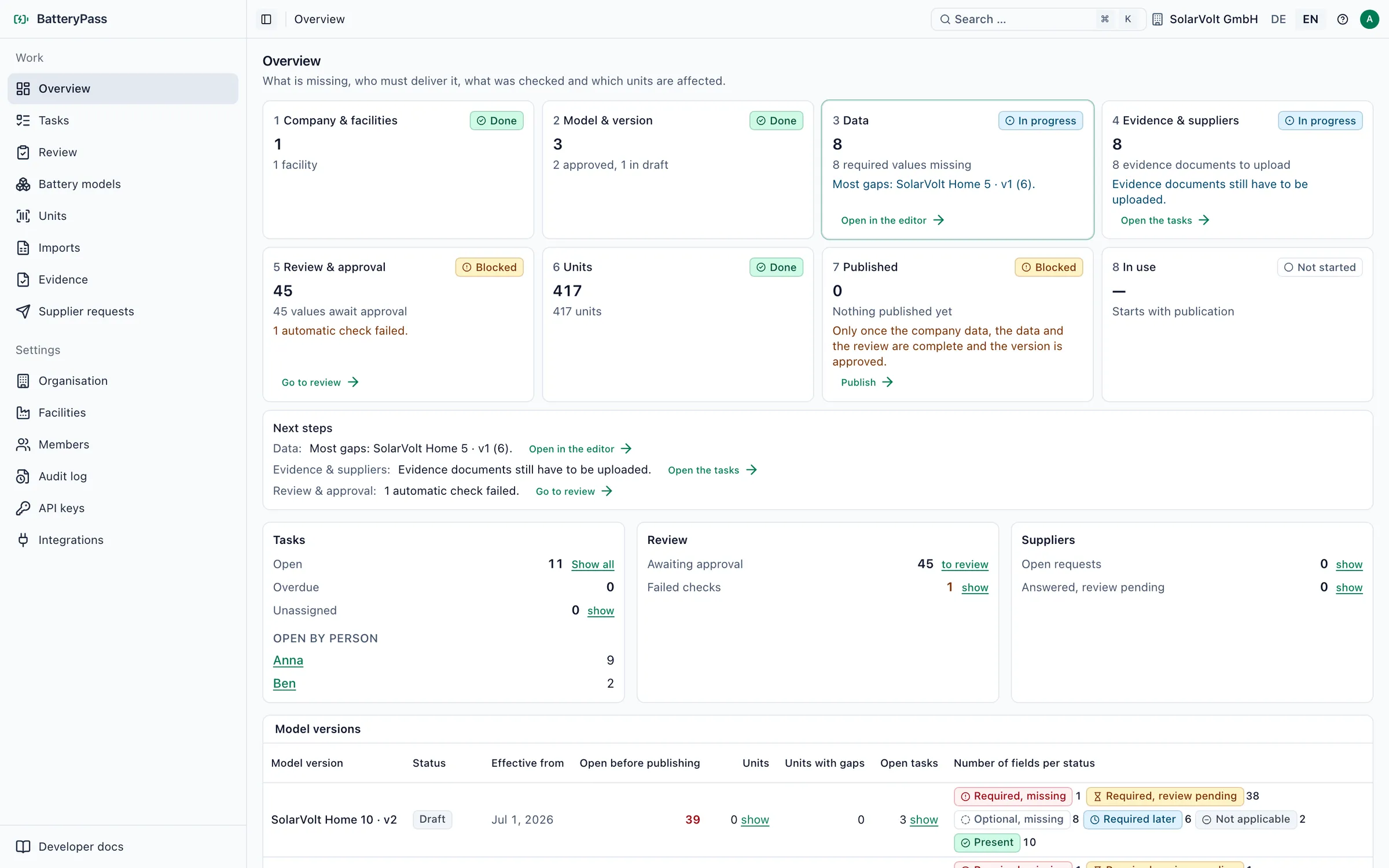
See what is missing and who has to deliver it
The dashboard shows, per model version and unit, which required information is missing, who has to deliver it, what has been reviewed and which units are affected.
Differences
What BatteryPass does differently
Model, version, unit
Maintain data once per model version, and per unit only the serial number and condition. Before you approve a new version you see which units it affects.
Import instead of retyping
Column mapping, unit conversion and row checks with an error report. Duplicate serial numbers show up before anything is taken over.
Provenance of every value
Every value carries its source, evidence, responsible person, review status and history.
Suppliers without an account
Suppliers get a link and fill in exactly the fields you asked for. A second person reviews before a value counts.
Honest requirement status
Required, conditional, not applicable with a reason, required later: per field and category from a versioned rule set instead of a percentage meter.
Passport operation done carefully
Access tiers enforced on the server, signatures that verify offline, versions by date, stable identifiers and a full export.
Integrations
Fits the systems you have
Your data lives in the ERP, in spreadsheets and with suppliers. BatteryPass reads it through imports and an open API instead of building one more island.
SAP, Microsoft Dynamics, Odoo and more: interfaces, matching workflows and when we checked them.
API and MCP serverRead data, report condition data, stage imports by key and poll for changes.
Security and data protectionAccess tiers on the server, four-eyes review, a log of every change, operation in the EU possible.
Knowledge
The EU battery passport, explained with sources
What the Battery Regulation requires, which acts are still missing and which data belongs in the passport: checked against the primary source, with the date of our check.
Which batteries need a passport, who is responsible, what goes into it and what is still open.
Implementation statusEvery pending act, every standard and the EU registry, with source and check date.
Data fieldsEvery field of our field registry with its access tier and requirement per battery category.
Status
Honest status: what is ready and what is not
We tag every feature as available, limited, in testing or planned. No customer runs BatteryPass in production yet, so almost everything is “in testing”.
- limitedAccess to restricted tiers for authorised partiesuntil the implementing act under Art. 77(9), only by grant per email address
- in testingUnit import from CSV and Excel with mapping, row checks and an error report
- in testingProvenance and history of every value, evidence with access tiers
- in testingFour-eyes review, a task for every gap
- in testingSupplier requests by link, without an account
- in testingSigned, versioned passports, preview per access tier, GS1 Digital Link QR codes
- in testingCondition data, repairs and second life
- in testingExports as BatteryPass v2.0 JSON and PDF, full organisation export
- in testingAPI keys, import by key, change feed, MCP server
- in testingERP integration patterns for 17 systemsPatterns over the API, no ready-made connectors
- in testingAI assistant in the portal, every change only after approvalcan be switched off; conversations go to Anthropic
- plannedManaged ERP connections, starting with Odoo
- plannedSubmission to the EU registrythe registry's API and its battery data model are not complete yet
- plannedTwo-factor sign-in and SSO for customers
. available: released to customers · limited: works within the limits named · in testing: built and tested, not yet used by a customer · planned: not built yet
Frequently asked questions about BatteryPass
Who is BatteryPass for?
For manufacturers and importers of batteries that need a battery passport, above all stationary storage and industrial batteries over 2 kWh. Typically a few models, hundreds to a few thousand units a year, and data that lives in Excel, ERP exports and supplier PDFs today.
Do we have to retype our data?
No. You upload existing spreadsheets and ERP exports. BatteryPass proposes the column mapping, converts units and reports duplicate or flawed rows before anything is taken over. More in the article on imports.
Who is responsible for the data in the passport?
The economic operator that places the battery on the market. BatteryPass shows who entered which value with which evidence and who reviewed it, but it does not take that responsibility away from you.
Is there an approval or an EU seal for battery passport software?
No. There is no approval and no EU seal for battery passport software, and for batteries the EU registry's API and data model are not complete yet. So we claim nothing of the kind and show our status openly on this page.
Can we connect BatteryPass to our ERP?
Yes, through the API with an organisation key: imports by key, a change feed to poll, and integration patterns for 17 ERP systems. We do not offer ready-made connectors yet. Details on the Integrations page.
What happens after publication?
The passport stays maintained: condition data, repairs and new model versions are published as a new signed version, and every earlier version stays retrievable by date. A repurposed battery gets its own passport that links to the old one.
Can we get our data back?
At any time. The full export contains every value, document and unit in a documented format that can be imported again.